TAMS 3 Solar Capital Investment Scheme

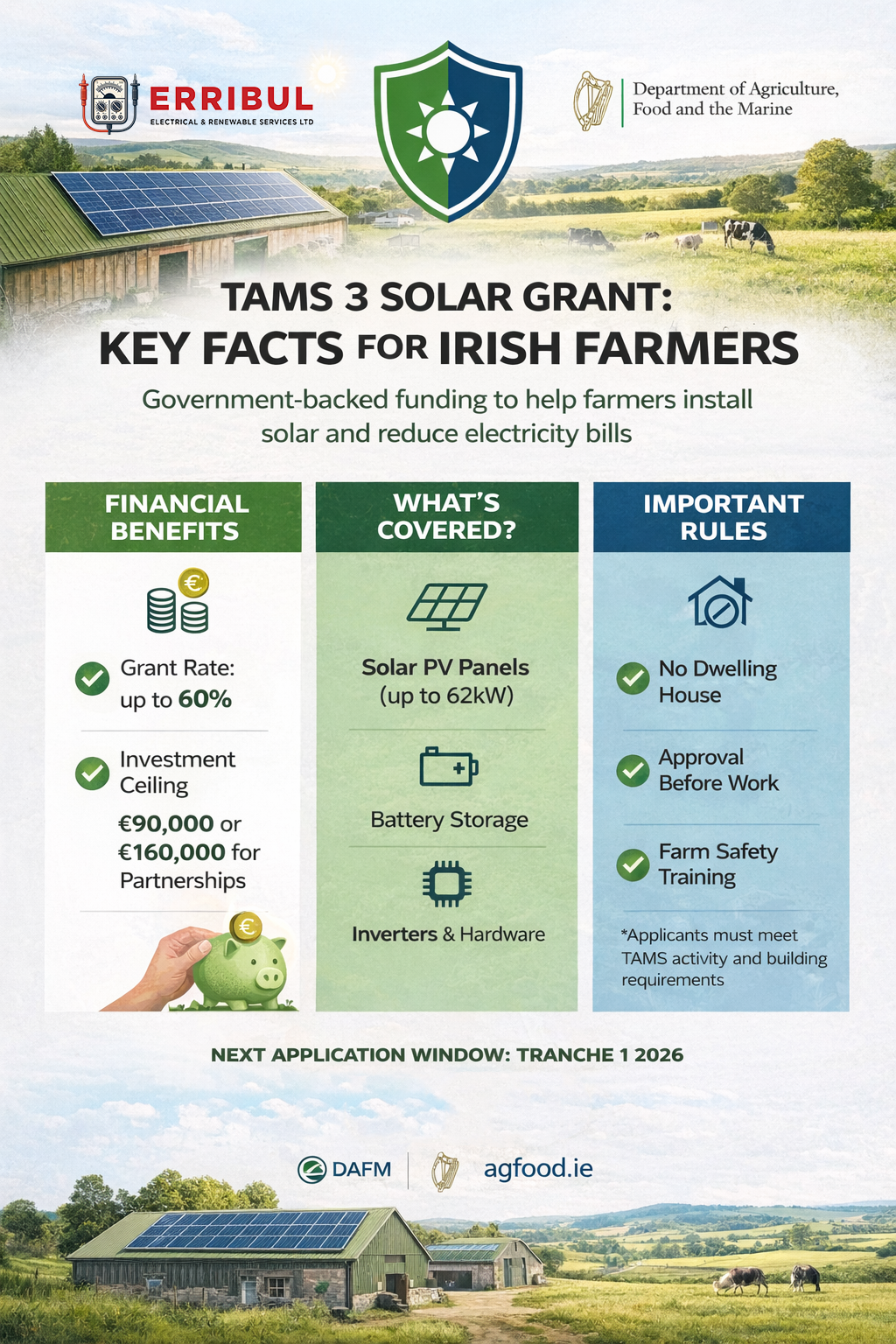
The SCIS is designed to help Irish farmers reduce electricity costs and their carbon footprint by installing Solar PV systems. This grant is administered by the Department of Agriculture, Food and the Marine (DAFM).
Key Financial Benefits
Grant rate is fixed at 60% of the eligible expenditure for all applicants. Investment ceiling is €90,000 per holding. This is a standalone ceiling, and you can still apply for the full €90,000 allowance in other TAMS 3 schemes, such as animal housing separately. For registered farm partnerships, the ceiling can increase to €160,000.
Minimum investment is €2,000 excluding VAT.
Eligible Investments
Solar PV panels up to a maximum of 62kW are covered. Battery storage is included as an eligible cost to help manage energy use at night or during peak times. Inverters and controllers necessary for a functional system are also included.
Eligibility Criteria. Applicants must be a registered farmer with a valid Herd, Flock or FE number.
They must own, lease or rent at least 5 hectares declared in BPS or BISS, while intensive enterprises such as pigs or poultry must generate a minimum of 20 production units. A BPS or BISS application must have been submitted in the year of application or the previous year.
A half-day Farm Safety Code of Practice course must have been completed within the last five years.
A valid Tax Clearance Certificate is required. The solar installation must be used for on-farm consumption only. Excess electricity can be exported to the grid via the Clean Export Guarantee (CEG), but the system must be sized based on the farm’s actual demand.
How to Apply
An approved installer must complete a professional Solar PV survey to verify energy needs and system sizing.
Documentation must then be gathered, including a farmyard layout plan, site location map, proof of land ownership or lease stamped by a solicitor, and company documents if applying as a limited company. Applications are submitted online through the agfood. i.e., portal, usually handled by an agricultural advisor. No work may begin until written approval is received from the Department, or the application becomes invalid.
Once approved, the installation must be completed and the claim submitted within 12 months.
Planning Permission
Solar PV on farms is often exempt from planning permission. Rooftop systems commonly qualify for exemption up to 300kW. Ground-mounted systems are typically exempt up to 75 square metres, roughly 15–17kW. Always confirm with the local authority or advisor, as special conditions such as proximity to airports or protected structures may apply.
Cost Savings
Agriculture is energy intensive, with electricity required for milking parlours, cooling, ventilation and lighting. Solar PV can reduce farm electricity bills by up to 75% depending on farm type and system size. With the 60% TAMS 3 grant many farms achieve full return on investment in approximately 3 to 5 years. Solar energy also protects farms from electricity price volatility and effectively locks in energy costs for over 25 years.
Synergy with Farm Schedules
Solar generation peaks during the day which aligns with demand on many farms. Dairy farms can power milking machines and milk cooling during daytime hours. Poultry and pig units can run ventilation and climate control when buildings are warmest. Robotic milking systems benefit from a steady supply of low-cost power for continuous operation.
Extra Income and Tax Advantages
Excess electricity can be sold back to the grid under the Clean Export Guarantee, creating an additional revenue stream. Farmers can claim Accelerated Capital Allowance and write off 100% of the equipment cost against tax in the first year. Non-VAT registered farmers may reclaim VAT through the VAT 58 form, noting panels currently carry 0% VA,T but other components may apply.
Futureproofing and Sustainability
A typical 25kWp system can offset over 7 tonnes of CO₂ annuall,y helping meet climate targets and improving environmental credentials with retailers and co-ops. Systems with battery storage can provide backup power during outages for essential services such as lighting and water pumps. Solar panels require minimal maintenance and typically last more than 30 years.
Rooftop Mounting
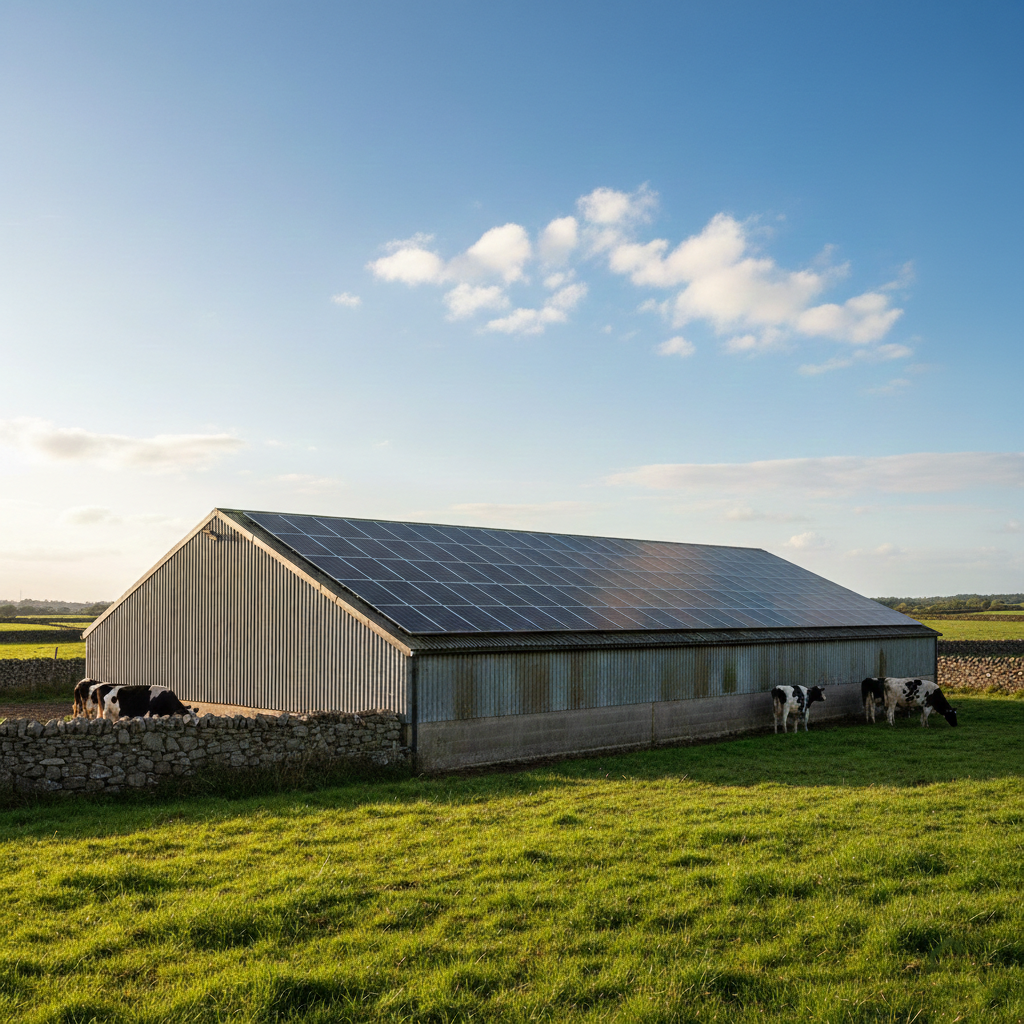
Mounting panels on existing farm buildings is the most common and cost-effective option as it uses unused roof space. Suitable locations include agricultural sheds, milking parlours and storage buildings. Panels cannot be installed on the farmhouse roof under TAMS 3. The roof must be structurally sound and skylights must remain clear. Planning permission is usually exempt for farm rooftops up to 300kW provided the site is not within a Solar Safeguarding Zone near airports.
Ground Mounting
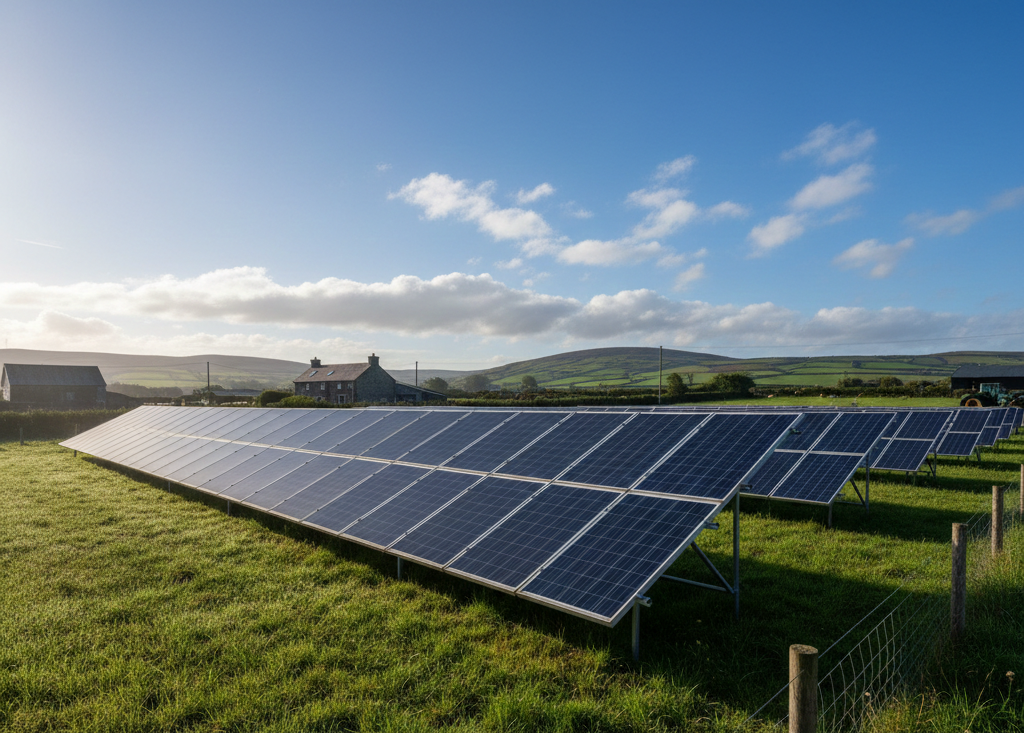
Ground mounting is suitable where roofs face north or are unsuitable structurally. Arrays must be within 500 metres of the farmyard and are often raised to allow grazing underneath. Systems are secured on metal frames with concrete footings or ground screws, and the inverter and equipment must be located in or beside the farmyard. Ground arrays are generally exempt up to about 15–17kW, while larger systems up to the 62kW TAMS limit normally require full planning permission.